Duct Replacement & Installation in Los Angeles
Designed for Your Home. Built to Perform.
- BEYOND REPAIR
When Duct Repair and Sealing Aren't Enough
Sealing a leaking duct stops heated and cooled air from escaping. Repairing a damaged section restores airflow to a room that wasn’t getting it. But some duct systems can’t be fixed with repair or sealing because the issue isn’t just a leak or a disconnected section — it’s the duct system itself.
Some duct systems simply weren’t designed for the equipment they’re connected to today. Ducts that are too small to move enough air. Layouts that made sense decades ago but don’t work with today’s equipment. Flex duct that’s deteriorated past the point where repair makes it functional again. These aren’t maintenance problems. They require new ductwork.
When the assessment points to replacement, we design and install a duct system that fits the home and the equipment — not a copy of whatever was there before.
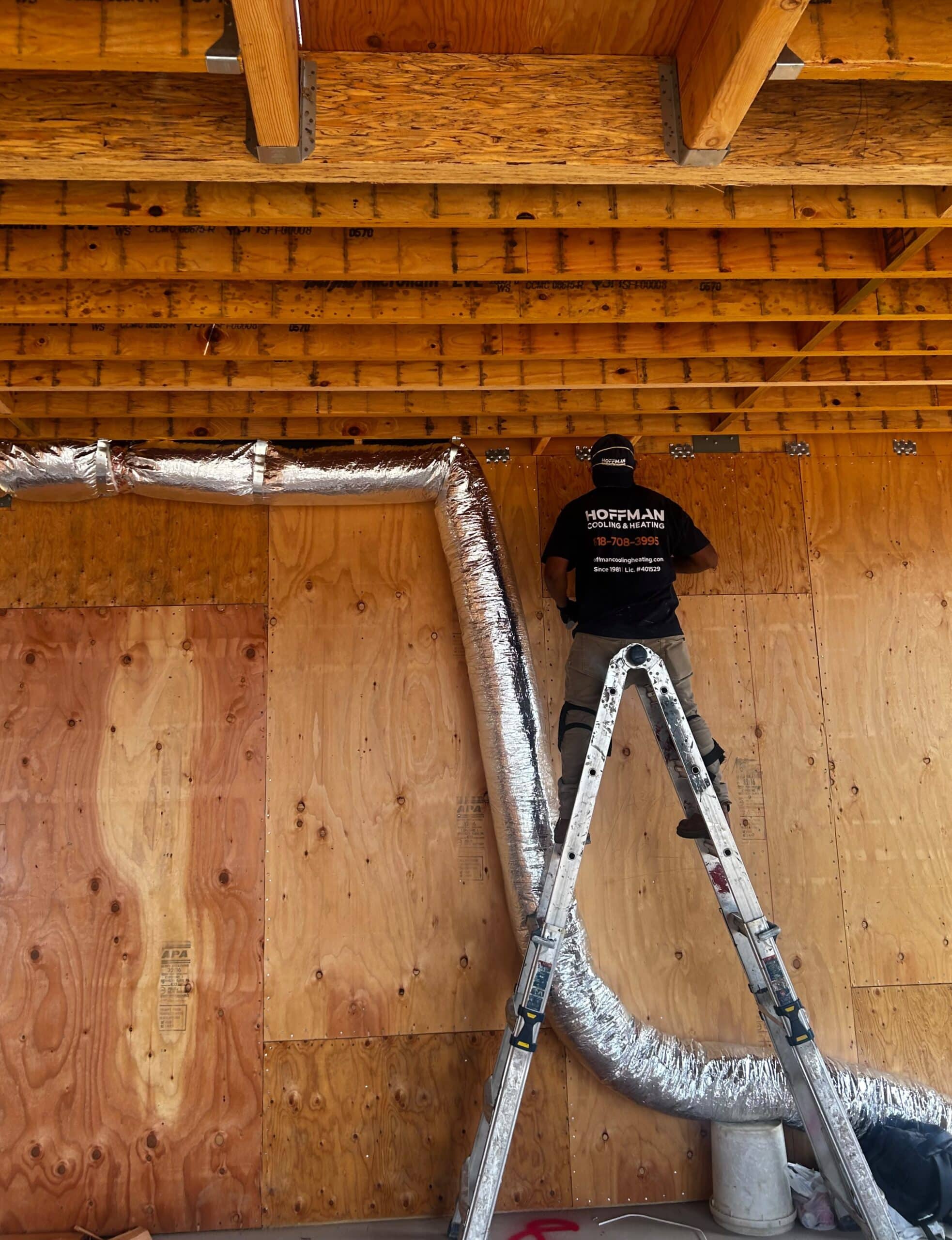
- WHAT LEADS TO REPLACEMENT
Common Reasons Ductwork Needs to Be Replaced
Four situations typically lead to duct replacement:
01
Layout
A lot of older LA homes have ductwork that was added onto over the years in ways that were easy to install but weren’t designed to perform well. Rooms that have always been uncomfortable. Areas of the house that never get enough air. Those aren’t maintenance problems — they’re design problems. The fix is a duct system designed to do the job.
02
Material deterioration
Older flex duct didn’t have the same UV protection used today. After years in a hot attic, the outer jacket and insulation can become brittle and begin to fail. When deterioration is widespread, replacement usually makes more sense than repeated repairs.
03
Sizing
When equipment gets upgraded, the existing ductwork sometimes can’t move the airflow the new system needs. The equipment works fine — the ducts are the bottleneck. Sealing or repairing doesn’t fix that.
04
Pest & Rodent Damage
Rats and other attic pests can tear insulation, chew through duct jackets, and damage multiple sections of the system. Once the damage becomes extensive, replacing large sections of ductwork is often the better long-term solution.
- BEFORE THE WALLS GO UP
Duct Installation for New Construction & Remodels
In new construction and major remodels, the duct system gets designed before the walls close in. Duct layout, airflow, and equipment placement all need to work together from the start. Once framing is set and drywall goes up, making changes gets a lot harder.
We work with general contractors, architects, and designers from planning through installation — building systems that move air properly, fit the house, and integrate cleanly with the rest of the project.
- DESIGNED FOR THE HOUSE
What a Proper Duct Replacement Involves
Replacing a duct system isn’t just pulling out the old and dropping in the new. The new system has to fit the house — how it’s laid out, how air moves through it, and what the equipment actually needs.
01
Designed for the Layout
We design the duct layout to fit how the house is actually built — not just where the old ductwork happened to run.
02
BALANCED AIRFLOW THROUGHOUT THE HOME
We design for balanced airflow throughout the home, instead of overcooling some rooms while others barely get enough air.
03
Return Air That Works
A duct system is only as good as its return side. We make sure enough air can get back to the system so it operates the way it should.
04
One Job, Not Two
When duct replacement happens alongside equipment replacement — as it often does — we treat it as one coordinated job from the start.
- THE RIGHT MATERIAL IN THE RIGHT PLACE
Duct Materials — What We Install and Why
In Los Angeles, most residential systems use flexible duct, while commercial systems often use rigid sheet metal, flexible duct, or a combination of both.
FLEXIBLE DUCT
- Common in attics and easier to run through tight spaces
- Performs well when properly supported and cleanly routed
- Problems often come from sharp bends, poor support, or careless installation
RIGID SHEET METAL
- More durable and holds its shape better over time
- Can be fabricated in different shapes and sizes to fit the available space
- Often the better choice where the routing or space makes flexible duct impractical
WE KNOW WHICH ONE BELONGS WHERE
- The right material depends on the building, where the ductwork is going, and what the system needs to do. After 45 years in these attics, we know which one belongs where.
Why Homeowners Call Hoffman for Duct Replacement
Good ductwork is planned, not squeezed in afterward. Airflow, return placement, and routing all affect how the system performs long-term.
We design duct systems around how air actually needs to move through the house. If the existing system can be repaired or sealed properly, we’ll tell you. If replacement is the right answer, we’ll explain why, then design and install a system that works the way it should.
Duct Installation & Replacement FAQ
Can you install ducts in a home that currently has no ductwork?
Yes. It’s more involved than replacing an existing system, but it’s done regularly in older LA homes built without central HVAC. The scope depends on the construction — attic access, wall cavities, and ceiling height all affect how the ductwork gets routed. In homes where ducting is particularly difficult, a mini-split system is often the cleaner solution.
Can duct replacement be done without replacing the HVAC equipment?
Yes, and sometimes it’s exactly the right move. If the equipment is in good shape but the duct system is failing, replacing the ducts alone can dramatically improve performance without the cost of new equipment. We’ll evaluate both and give you an honest read on where the problem actually lives.
How much does duct replacement cost in Los Angeles?
Duct replacement cost varies based on the size of the home, attic accessibility, and how much of the system needs to be replaced. It’s a meaningful investment — but when the duct system is significantly compromised, replacing it can completely change how the house heats and cools.
How long does a new duct system last?
A properly installed system using quality materials should last 25–30 years or more. The weak points are typically the flexible duct sections and the connections at registers and air handlers — these are worth inspecting periodically, especially in homes with attics that get very hot in summer.
Can bad ductwork make a high-end HVAC system perform poorly?
Yes, consistently. The duct system is what delivers the air the equipment produces — if it’s undersized, poorly laid out, or leaking, even good equipment won’t perform the way it’s supposed to. We’ve seen brand new high-efficiency systems in older LA homes that couldn’t keep up because nobody looked at the ductwork. Equipment is only half the picture.
Does new ductwork improve airflow and comfort?
Yes, and in most cases, significantly. A properly designed duct system makes a noticeable difference in how evenly the house heats and cools. Rooms that have always been uncomfortable often improve once the airflow is balanced properly throughout the house.
How important is duct design during an HVAC installation?
Duct design is as important as equipment selection. The size of the ducts, the location of the supply and return registers, and the path the air travels determine how well the system performs day to day. A system designed around the home’s layout outperforms one where the ductwork was squeezed in afterward — even with identical equipment.
Think Your Duct System Needs More Than a Fix?
If you’ve had repairs done and the house still isn’t right, or you’re planning an equipment replacement and want to know if the ductwork is holding the system back, we’ll assess the duct system and tell you whether it makes sense to repair what’s there or if replacement is the better long-term solution.