Duct Repair in Los Angeles
Damaged Ductwork Shows Up in Every Room
- YOU FEEL IT BEFORE YOU SEE IT
Signs Your Ductwork May Need Repair
A damaged duct system doesn’t announce itself. It usually shows up as a room that never cools down, a system that runs longer than it should, or an energy bill that seems high compared to the comfort you’re getting. By the time most homeowners connect those symptoms to the ductwork, the problem has usually been there for a while.
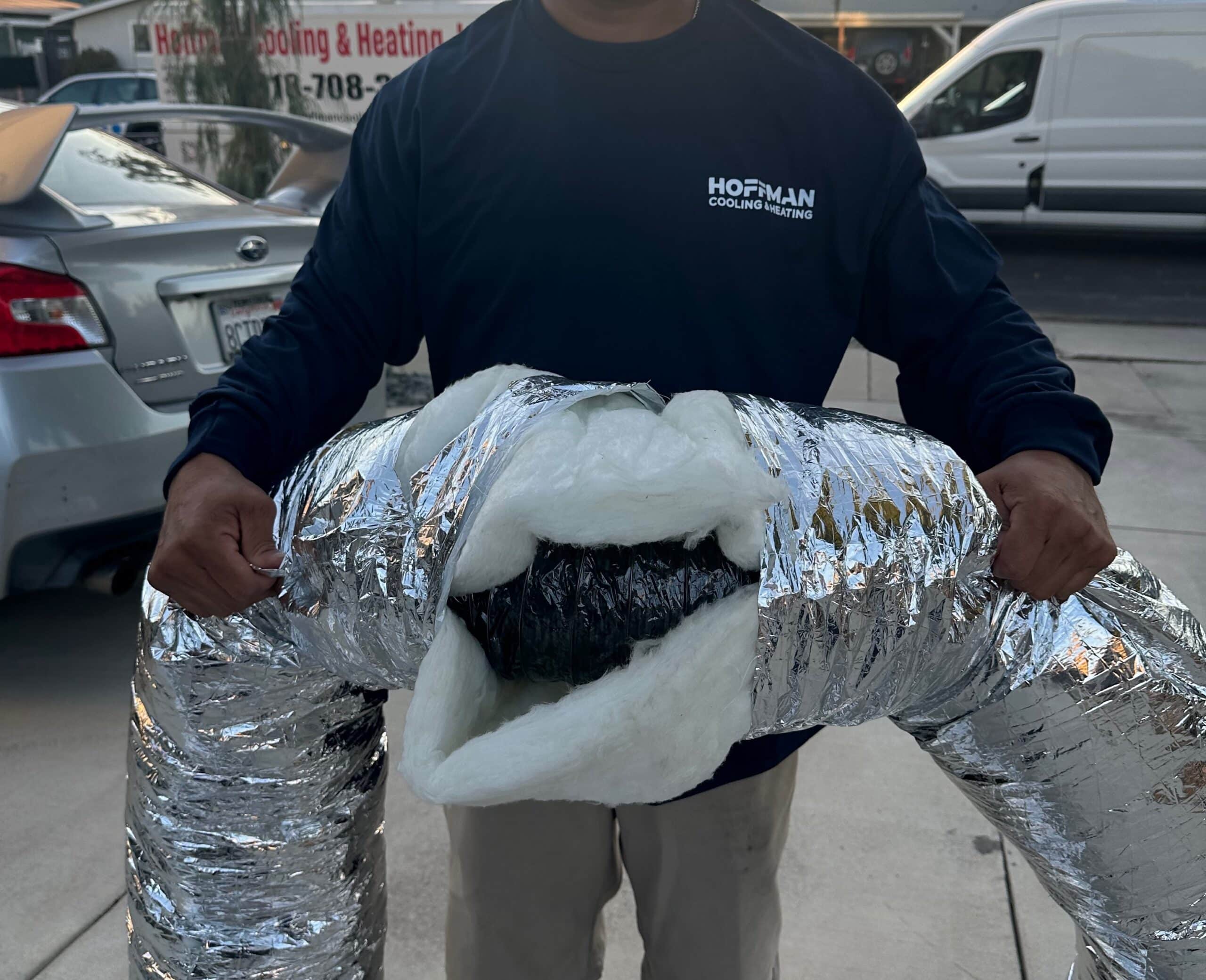
Most duct repair calls we get in Los Angeles involve flexible duct that’s collapsed, kinked, or pulled apart at a connection. Flexible duct is common in attics because it’s easier to run through tight spaces, but it’s also easier to damage over time. A collapsed section restricts airflow to the rooms it serves. A disconnected section sends conditioned air into the attic instead of the house.
Most homeowners never see the ductwork — but when something’s wrong, they feel it throughout the house.
- HOW DUCTS FAIL
What We Usually Find
Most duct problems in Los Angeles fall into a few recognizable categories — and most of what we find is in the attic.
01
COLLAPSED & SAGGING FLEX DUCTS
Flexible ductwork can collapse or sag when it isn’t properly supported. Over time, attic heat and gravity reduce airflow and make the system work harder.
02
DISCONNECTED JOINTS & AIR LEAKS
We often find loose or disconnected duct joints, failed tape or fasteners, and air leaks that send conditioned air into the attic instead of the rooms below.
03
CRUSHED, PUNCTURED & AGING DUCTWORK
Ductwork can be crushed during attic work, punctured, or deteriorate over time. Rigid metal ductwork can also rust from years of condensation.
- WHAT YOU CAN'T SEE FROM BELOW
How We Find It
Duct problems in an attic aren’t always obvious from below. A room that won’t cool is usually just the symptom. The cause is often sitting somewhere in the attic where nobody’s looked in years.
We get up there. We follow the duct runs, check the connections, look for sections that are kinked, collapsed, or separated. If one room consistently underperforms compared to the rest of the house, we trace it back to the source.
The thermostat can tell you something isn’t right. It can’t tell you why. The attic is where the answers are.
- REPAIRING THE DAMAGE
How We Fix It
The right repair depends on what’s wrong and what the ductwork is made of.
01
FLEX DUCT SEPARATION
When a flex duct pulls apart at a connection, we reconnect it properly, seal the joint, and provide the support needed to keep it in place.
02
CRUSHED OR KINKED FLEX DUCT
Once a flex duct loses its shape, airflow remains restricted. Severely damaged sections are typically replaced rather than straightened.
03
DAMAGED METAL DUCTWORK
Damaged metal ductwork can often be repaired and sealed. When the damage is extensive, the affected section may need to be replaced.
04
SURROUNDING DUCTWORK
When we’re repairing ductwork, we also look at the condition of the surrounding sections. Fixing one disconnected section doesn’t solve much if the ductwork around it is also coming apart.
- ISOLATED PROBLEM OR BIGGER ISSUE?
Repair or Replace — How We Make That Call
Duct repair makes sense when the system is fundamentally sound and the problem is isolated—a disconnected joint, a collapsed section, or damage in one area. Repair addresses the specific failure while the rest of the system continues doing its job.
WHEN REPAIR MAKES SENSE
- The damage is limited to one area
- A connection has come apart
- A section has collapsed or become restricted
- Airflow issues can be traced to a specific failure
- The rest of the duct system remains in good condition
WHEN REPLACEMENT MAY MAKE MORE SENSE
- Ductwork is deteriorating throughout the attic
- Multiple repairs are needed in different areas
- Poor airflow throughout the entire home
- The ductwork is undersized for the equipment
- The duct layout wasn't designed to distribute air properly
We look at the full picture
- We evaluate the condition of the entire duct system, the equipment it's connected to, and how the home performs before making a recommendation. If repair makes sense, we'll tell you. If replacement is the better long-term answer, we'll tell you that too.
Why Homeowners Call Hoffman for Duct Repair
Duct repairs should solve the airflow issue, not just patch the visible damage.
We look at the surrounding ductwork too, because one disconnected section is sometimes just the symptom of a bigger problem. We find the cause — not just the symptom — and repair it the right way with materials that hold up. If the duct system needs more than a simple repair, we’ll tell you what makes sense and why.
Duct Repair FAQ
Can bad ductwork make certain rooms hard to heat and cool?
Yes. Damaged or disconnected ductwork is one of the most common reasons rooms don’t heat and cool properly.
It creates airflow restrictions that starve specific parts of the house while the equipment runs fine. The system appears to be working — the air just isn’t getting where it needs to go. If certain rooms are consistently uncomfortable regardless of the thermostat setting, the duct system is worth looking at.
How do I know if my ductwork needs repair?
Poor airflow from certain vents, rooms that never seem comfortable, higher energy bills, or excess dust can all be signs that ductwork needs repair. In older Los Angeles homes, attic ductwork is often partially disconnected, crushed, leaking, or deteriorated. The only way to know what condition the system is actually in is to get up there and inspect it.
Can damaged ducts be repaired without replacing the whole system?
In most cases, yes. Disconnected sections can be reconnected, collapsed flex duct can be replaced in sections, and leaking joints can be sealed without touching the rest of the system.
A full replacement is sometimes the right call — but it’s not always necessary, and we won’t recommend it if targeted repairs will do the job.
What causes flexible duct to collapse or disconnect?
Flexible duct is more vulnerable than rigid metal ductwork. It can be crushed by someone working in the attic, pulled loose at connections over time, or eventually break down from age and heat.
If nobody has been up there and the ductwork was installed properly, it will often last for many years without issues. Sometimes, though, we find a damaged or disconnected section that’s been affecting airflow for years without the homeowner knowing it.
Can a collapsed flexible duct be straightened out?
Sometimes, but usually not in a way that lasts. Once flex duct gets badly kinked or crushed, airflow usually doesn’t fully recover. The reliable fix is replacing the damaged section with new material, properly supported and connected. It’s not a major job, and it makes a real difference.
How long does duct repair last?
Done correctly with quality materials, duct repairs hold up for 20 years or more. The key is repairing the duct correctly, supporting it properly, and making sure the repair fixes the actual problem instead of temporarily patching over it. Standard duct tape — the kind you find at the drug store — doesn’t hold up well in attic heat over time.
When One Room Never Feels Right
If one area of your home never seems as comfortable as the rest of the house, the ductwork serving it is worth checking. We’ll get up there, find what’s going on, and tell you what needs to be repaired and why. Then we’ll fix it the right way.